



Personal guidance
Full attention for every participant

Innovative materials
See improvisation from a completely new perspective

Expert
More than 25 years of experience guiding musicians
Registered course
The course meets CRKBO quality standards
Who is it for?
The Training to become an Improvisation Coach is for you if you recognise yourself in the following:
- You have completed the year-long training FREE YOUR MUSIC. Or you have picked up the basics of improvisation in another way.
- You want to continue growing in your improvisation skills.
- You want to share what you have learned with others and teach it: you long to work as an improvisation coach.
- You play your instrument at a somewhat advanced level.
- You have a basic knowledge of harmony theory, and you can do sound diving.
- You realise that music can be of great, positive value to people. You know that music can give people energy, touch them, comfort them, heal them, connect them with each other, and make them happy. You want to commit yourself to using music to promote joy in life.
Content of the Training to become an Improvisation Coach
When you have completed the Training to become an Improvisation Coach, you will have mastered the following ten subjects:
- Mindset
- Sound
- Timing
- Structure
- Ensemble Playing
- Listeners
- Innovation
- Instrument Mastery
- Harmony Theory
- Didactics
1. Mindset
- You are able to feel and follow your own impulses from within.
- You dare to trust your own taste and intuition.
- You know the phenomenon of the magical boundary (see the book FREE YOUR MUSIC), and you are able to feel at any moment where yours lies, and to accept it.
- You feel happy when you think about your instrument.
2. Sound
- You can do sound diving, and you know the four steps of the sound dive.
- You realise that there is a big difference between a consonance and a dissonance. You feel that difference and make it audible with every sound. You can produce many different sound nuances on your instrument.
- You know how to naturally integrate 'wrong' notes into your improvisations, so that they are no longer 'mistakes'.
- You are familiar with a number of different sound improvisations, and can perform them.
- You realise that making music is about feeling, listening, and enjoying. You always play every note with attention.
- You realise that sound and silence belong together. You know the impact of the end of a note on the silence that follows, and you have experimented with this. You are able to continue improvising naturally after a silence, so that the silence naturally finds its place in your improvisation. You can carry the silence after your improvisation with you into your day.
3. Timing
- You can maintain a tight yet 'living' pulse.
- You are energetically relaxed, and your timing swings as if you are dancing.
- You have mastered the 'aspen tree rubato', where your left hand (or your foot) maintains a tight pulse, while your right hand (or your wind or string instrument or your voice) plays freely, rubato, over it.
- You can improvise in regular time signatures (2/4, 3/4, 4/4, 6/8), in irregular time signatures (5/4, 7/4), and in irregular divisions within a regular time signature (for example 3 + 3 + 2 = 8).
- You realise that a note on a strong beat has a very different character than a note on a weak beat (syncopation). You make that difference audible during your improvisations.
4. Structure
- You are able to create a beautiful arc of tension across your improvisations.
- You are able to create an improvisation based on a given motif, melody, or chord progression.
- You can, if desired, create an improvisation in rondo form, in ABA form, in AABA form, and in ABAC form.
5. Ensemble Playing
- In ensemble playing, you are able to perceive the other(s) very well and respond to them, while simultaneously staying close to yourself and never losing yourself. In other words: you manage to feel connected to your fellow musicians, while at the same time following your own feeling.
- You know the phenomenon of synergy, and you apply it when playing with others.
- You can lead and you can accompany. And during an improvisation with others, you are able to consistently make good choices between leading and accompanying.
- You can lead group improvisations through gestures.
6. Listeners
- When someone asks you: 'Improvise something', you calmly take your place at your instrument and play something that the other person enjoys - and so do you!
- If necessary, you know how to apply BASTA (a mini-therapy to permanently overcome your nerves - see the book FREE YOUR MUSIC).
- When you play for others, you no longer wonder 'what others think of you' and you are no longer focused on the greater glory of your ego, but you place yourself in service of the music and your audience, and you enjoy your improvisation together with your listeners.
- You experience your fellow students and colleagues not as sources of competition, but as sources of inspiration.
- You see music not as a competition, but as a gift to help us live.
- You have stopped 'ladder thinking' and started 'circle thinking' (see the book FREE YOUR MUSIC).
7. Innovation
- You continue to renew yourself - and you know the necessary tricks to do so.
- You are able to improvise in a number of different styles - including your own style.
- You realise that singing, percussion, and dance form the basis of music. You do not hesitate to sing, dance, or play percussion, and to use these in your own music-making and teaching.
8. Instrument Mastery
- You play your instrument at an advanced level.
- You can effortlessly accompany well-known sing-alongs (birthday songs, Christmas carols) in a number of different keys.
- You are able to enter a state of flow from the very first note you play - and to maintain that flow until the end of your improvisation. You enjoy every note you play and radiate that enjoyment.
- You are able to make a new composition your own through sound diving. And you can improvise on an existing composition.
- You have a basic knowledge of instruments other than your main instrument. You know how to learn to play a new instrument through sound diving.
9. Harmony Theory
- You know the characters of the seven notes of every key, and you can improvise a 'key piece' (see the book The Fifth Factor) in all 24 keys.
- You know the characters of all intervals.
- You know the seven degrees of every key, and can improvise a 'three-degree piece' (see the book The Fifth Factor) in every key.
- You are familiar with chord inversions and the concept of the dominant seventh chord in first inversion, and you can apply these in your improvisations.
- You know the three different forms of minor.
- You are at home in the circle of fifths and can play it on your instrument. You can modulate.
- You are familiar with the concepts of augmented fourth, flattened second, chromaticism, secondary dominant, Neapolitan, altered chords, and chromatic passing chords, and you can apply these in your improvisations.
- You know the gypsy scales, the church modes, the pentatonic scales, the blues scales, the whole-tone scales, the octatonic scales, and you can improvise in these scales. You know something about jazz harmony and know the sus chords and quartal chords, and you can apply these in your improvisations.
- You understand what overtones are. You know the overtone series of every note and can play it on your instrument. You understand the impact of the overtone series on the phenomena of consonance and dissonance.
- You are familiar with chord symbols, and can improvise from a lead sheet.
10. Didactics
- You are able to teach others what you yourself have learned.
- You are able to create a safe atmosphere for your students. You realise how important a safe atmosphere is, because your students will only produce the happiness hormone oxytocin, which plays such an important role in the creative process, in a safe atmosphere.
- You treat your students positively. You can observe without judging. You can 'mirror' (verbally hold up a mirror to your student). You are able to always say something positive about your student's improvisation, and to communicate the student's growth opportunities in a constructive way.
- You radiate enthusiasm, respect, and trust towards your students.
- You are able to see and enjoy what is authentic in every student. You are able to use a different, suitable approach for each student at each age.
- You are able to perceive whether your students' movements and sounds are spontaneous or learned/thought up.
- You are able to let your students experience the joy of improvising. You know how to 'open' your students and let them come into their power. You know the satisfaction this brings.
- You do not hesitate to demonstrate something for a student when appropriate.
- You realise that everyone, including yourself, is learning every day and continuously developing. You realise and accept that you don't know and can't do everything. You are open to learning from your own students.
- You know the enormous impact that music can have on people. You want to commit yourself to increasing the total amount of joy in life on this earth through music and improvisation - and you now know how to do that.
- You feel yourself to be an Improvisation Coach, and you are happy to call yourself one.

Structure of the training
- Seven full-day group training sessions (approximately six hours of training, plus roughly one hour break including a served lunch)
- One private lesson of one hour
- Free access to all my video courses
- Including three training books
- Homework assignments
- Diploma 'Improvisation Coach'


Start date
The next course starts in September 2027.
We have decided to make our schedule a bit less packed, so we now organise some courses not every year, but only once every two years.
RegisterDiploma
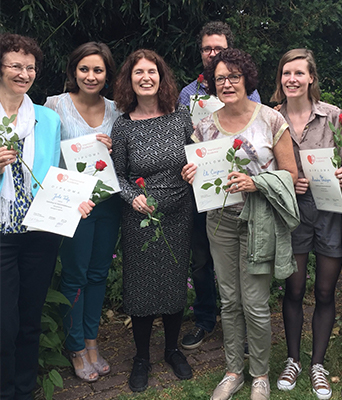
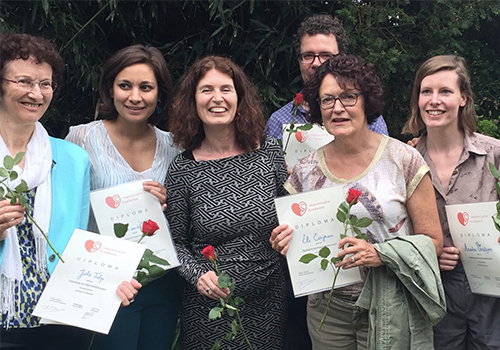
When you have sufficiently mastered all ten subjects mentioned above, you will receive the (accredited) diploma 'Improvisation Coach'. Assessment takes place using 'block cards'. The intention is that per subject, per component, two blocks will be fully coloured: one block is fully coloured by you, when in your own opinion you have sufficiently mastered that component; one block is fully coloured by Improvisation Academy 'De Tonedive', when in the academy's opinion you have sufficiently mastered that component.
If at the end of the training not all your blocks are coloured, you may continue for as long as you wish to develop your skills in that subject/component, in order to get all blocks coloured and thereby earn your diploma. If desired, support, moral encouragement, and help can be provided by Improvisation Academy 'De Tonedive'.
Study load
The study load of the Training to become an Improvisation Coach can vary greatly per student. At minimum, you are expected to play at least one note with full attention every day: that means a study load of at least 30 seconds per day. In addition, you will (re)read the books Tonediving, Free Your Music, and The Fifth Factor, and you will develop your skills in the ten subjects mentioned above. Depending on your starting skills and learning speed, the total study load can vary between 30 seconds and two to three hours per day.
Musical Intention
When receiving your diploma, you speak the 'Musical Intention'. I came up with the idea of the Musical Intention during the medical exam of our daughter Anna. When receiving their diploma, doctors take the 'physician's oath' (formerly the 'Hippocratic oath'). All doctors in the Netherlands have had to take the physician's oath.
I found it impressive to witness my own daughter's physician's oath. All those young people, who in front of a company of witnesses say 'I promise'. They promise, in short, that they will use the knowledge and skills they acquired during their medical studies in an honest way, in service of their fellow human beings.
When our daughter also said 'I promise', something went through me. I became very happy. I think it is wonderful that the physician's oath exists.
And I thought: we music teachers / improvisation coaches also have knowledge and skills that can 'make or break' people. As music teachers / improvisation coaches we can make an enormous contribution to the joy of life of many people, by taking them along into the richness and enchantment of making music themselves. Yet who has never met someone who says they were 'broken' by their music teacher? Nobody wants people to become unhappy through music education – and yet it happens.
I think it is important that, when receiving your diploma, you realise that music education is not only about passing on knowledge and skills. It is about more than that.
By speaking the 'Musical Intention', you indicate that you want to commit yourself to using music to promote joy in life.
Testimonials
Through the training, I discovered my hidden talents and was able to let them flourish. The confidence I gained that what I do is good makes me happy. With many thanks to Robijn who shaped her expertise into enthusiastic, inspiring, and effective lessons.

Thanks to the training, I now dare to do much more with students. I deal with students much more easily, with more self-confidence. Before the training, I often felt tense and insecure, I often kept myself in the background. Not anymore. I dare to take my place and enjoy people listening to my piano playing: a completely new sensation!

A wonderful training. I enjoyed it enormously. The 'block cards' were great as a concrete overview of everything there is to learn and to monitor and become aware of one's own progress. Your books were enormously supportive.

Thank you so much for the wonderful training, and especially thank you sooooo much for teaching me to be free and to improvise. Robijn, you are a wonderful person.

You are simply amazing. You have a wonderful energy and inspiring power. You are completely present in what really matters. You are what you teach us.

You always had a practical, meaningful, fitting answer to every question and every problem. The block card system without exams is truly very progressive. Superb!

What does the training cost?
Tuition
The tuition fee for the Training to become an Improvisation Coach is EUR 1,795. This tuition covers the seven group training days (including lunch), the private lesson, the three training books, the homework assignments, the block cards, and the diploma. Plus one year of free access to all my video courses. The Improvisation Academy is registered with the CRKBO and is therefore exempt from VAT. You can pay in instalments if you wish.
Training books
Included in the tuition fee are the three training books Tonediving, Free Your Music, and The Fifth Factor. If you already own these books, the cost of these is waived, and you can deduct their price from the tuition fee.
Discount?
If you really want to do the Training to become an Improvisation Coach, but you cannot afford the costs, please contact us. If the Training is your dream, we believe that costs should not be an obstacle for you to realise your dream...!
Registration
Does the Training to become an Improvisation Coach appeal to you and would you like to register? Click here.
If you think: 'Such a training might be for me, but I'm not sure, I still have some questions', please email your questions to robijntilanus@gmail.com. Always include your phone number in your email: Robijn can then call you back or leave you a message, if she feels that is the best way for her to respond.
RegisterFAQ
You can participate with any instrument. No instruments are excluded. Singers can also participate.
The training sessions and private lessons are given in the barn of our farmhouse. Address: Dorpsstraat 39, Uffelte, South-West Drenthe, The Netherlands (near Meppel). A hundred metres walk from the Holtingerveld, a stunning nature area with forest, heather, drift sand, ponds, and two dolmens.
The group training days are given on weekdays from 10:30 AM to 5:30 PM. Halfway through the training day there is roughly one hour break, during which lunch is served. The private lesson is arranged individually.
The number of participants is a minimum of four and a maximum of ten.
The training to become an improvisation coach lasts one year.
We start once a year, in September or October.
The Training to become an Improvisation Coach is at HBO level (applied university level): you are expected to be able to function at least at HBO level. This is mainly about thinking level, and less about diplomas.
If you come from far away and cannot manage to make the journey in the morning, you are welcome to come and stay the evening before. Expect basic comfort, not a star hotel. We ask you to bring your own bottom sheet (or a sheet bag), a pillowcase, and a duvet cover. We have duvets, blankets, and a bed for you. If you prefer camping, that is also possible: there is plenty of space on our grounds for your tent or camper. You can of course also choose to find a B&B or hotel in our area if you prefer more comfort.
Of course! Please send your dietary requirements to us by email well in advance.
Uffelte is in the south-west corner of Drenthe. From the Randstad, it is roughly an hour and a half by car, depending on your starting point. If you come by train, go to Meppel station. From there, continue by bus 28, direction Dwingeloo. After fifteen minutes, get off at the Anserweg stop in Uffelte (Note: do NOT take the Dorpsstraat stop in Uffelte, as it is much further to walk. Also do NOT take the Dorpsstraat stop in Havelte, as you will be in the wrong village). From the Anserweg stop, it is approximately a ten-minute walk to Dorpsstraat 39.